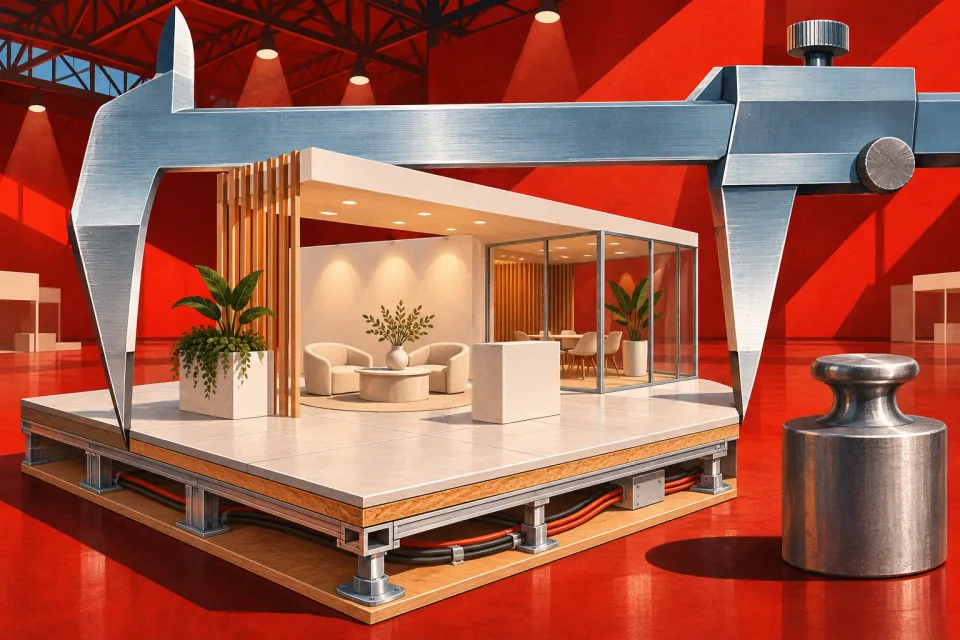
Builder rate cards, RFP responses and annual stand-build invoices from a panel of 1,400 stand-build invoices per year on average come together to make up the benchmark. The 2026 resource for pricing exhibition stand builds across Europe is complete and covers per square metre rates by build type, country and stand profile as well as all-in budget envelopes for 50-, 100-, 200- and 400-sqm stands.
The matrix is published as a public reference for exhibitors, procurement teams and journalists covering the exhibition stand industry. Updates are biannual (January and July) to track material costs, labour rates and exchange rate movements.
Methodology
What’s included in per-sqm pricing: stand design (concept + 3D + technical drawings), materials and fabrication, on-site installation, dismantle, freight to one European venue, project management, build insurance, basic lighting, basic graphics, basic furniture.
What’s excluded from per-sqm pricing: AV technology rental (LED walls, screens, AV equipment), advanced demo equipment integration, hospitality catering, premium furniture rental, fair-organiser space rental, on-site catering services, post-event storage, change orders during build week and expedited or out-of-hours labour are all excluded. Custom interactive technology is as well.
Sample size: The price takes into account over 1,400 stand-build invoices from the 2024-2026 cycles across the panel and 2026 numbers are projected against a 2025 base plus 2.8% European stand-build cost inflation.
Headline pricing matrix, EUR per square metre
Modular rental, in-line stand (12-30 sqm)
| Country | Low | Median | High |
|---|---|---|---|
| Germany | €350 | €475 | €650 |
| Italy | €330 | €440 | €610 |
| France | €340 | €460 | €640 |
| Spain | €295 | €405 | €560 |
| Netherlands | €380 | €510 | €680 |
| UK (£→€) | €340 | €475 | €625 |
| Poland | €200 | €290 | €400 |
Modular hybrid, peninsular stand (50-100 sqm)
| Country | Low | Median | High |
|---|---|---|---|
| Germany | €580 | €730 | €950 |
| Italy | €520 | €670 | €890 |
| France | €560 | €710 | €930 |
| Spain | €470 | €620 | €830 |
| Netherlands | €600 | €760 | €1,000 |
| UK | €530 | €690 | €900 |
| Poland | €350 | €495 | €650 |
Custom design, peninsular stand (50-100 sqm)
| Country | Low | Median | High |
|---|---|---|---|
| Germany | €960 | €1,380 | €1,850 |
| Italy | €890 | €1,290 | €1,750 |
| France | €920 | €1,330 | €1,800 |
| Spain | €780 | €1,180 | €1,620 |
| Netherlands | €1,000 | €1,440 | €1,950 |
| UK | €905 | €1,310 | €1,810 |
| Poland | €640 | €930 | €1,250 |
Custom design, island stand (150-300 sqm)
| Country | Low | Median | High |
|---|---|---|---|
| Germany | €1,460 | €2,000 | €2,800 |
| Italy | €1,370 | €1,890 | €2,640 |
| France | €1,410 | €1,940 | €2,720 |
| Spain | €1,210 | €1,710 | €2,420 |
| Netherlands | €1,510 | €2,080 | €2,920 |
| UK | €1,395 | €1,920 | €2,765 |
| Poland | €940 | €1,360 | €1,830 |
Custom flagship stand (400+ sqm)
| Country | Low | Median | High |
|---|---|---|---|
| Germany | €2,100 | €2,950 | €4,500+ |
| Italy | €1,960 | €2,770 | €4,250 |
| France | €2,010 | €2,840 | €4,350 |
| Spain | €1,720 | €2,490 | €3,890 |
| Netherlands | €2,180 | €3,060 | €4,650 |
| UK | €1,975 | €2,820 | €4,440 |
| Poland | €1,420 | €2,070 | €3,200 |
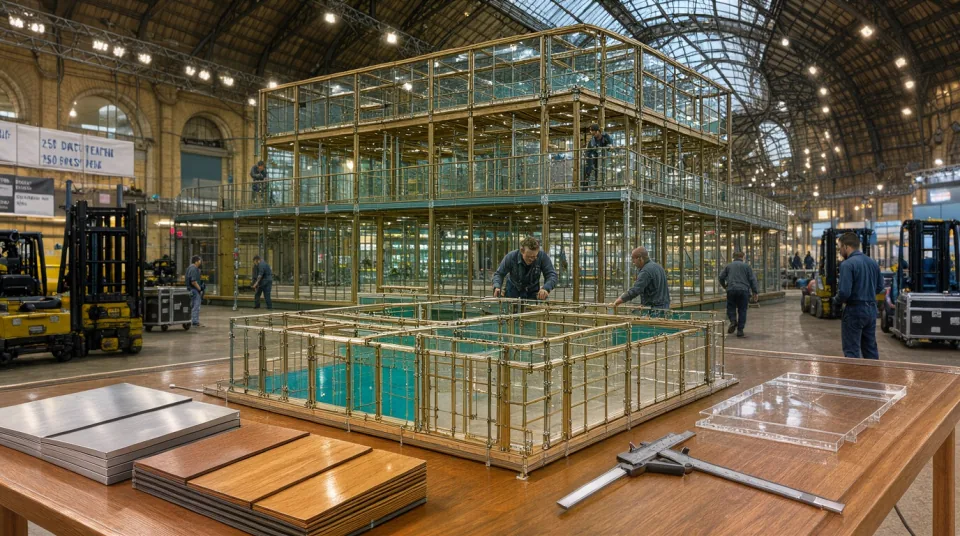
Double-decker premium stand (200+ sqm with engineered upper floor)
| Country | Low | Median | High |
|---|---|---|---|
| Germany | €2,940 | €3,950 | €5,500+ |
| Italy | €2,740 | €3,700 | €5,200 |
| France | €2,810 | €3,800 | €5,330 |
| Spain | €2,400 | €3,310 | €4,800 |
| Netherlands | €3,050 | €4,090 | €5,690 |
| UK | €2,755 | €3,720 | €5,290 |
| Poland | €1,950 | €2,750 | €4,000 |
One column per table above. Shading runs from the lowest to the highest figure within each column.
All-in budget envelopes by stand profile
A practical reference for budget planners. The envelopes cover the per-sqm stand-build cost as well as the most common extra cost lines (AV technology, freight, project management surcharge, change orders, post-event storage and refurbishment). Fair-organiser space rental and on-stand catering services are EXCLUDED.
50 sqm peninsular stand at a Tier-1 fair
| Tier | All-in budget envelope | Use case |
|---|---|---|
| Budget | €35,000-€55,000 | First-time exhibitor, modular rental |
| Mid-tier | €70,000-€120,000 | Established mid-market B2B brand |
| Premium | €140,000-€220,000 | Major brand with bespoke design |
100 sqm peninsular stand at a Tier-1 fair
| Tier | All-in budget envelope | Use case |
|---|---|---|
| Budget | €60,000-€95,000 | Modular hybrid, repeat-fair brand |
| Mid-tier | €120,000-€220,000 | Mid-market with custom feature wall |
| Premium | €240,000-€380,000 | Premium brand custom design |
200 sqm island stand at a Tier-1 fair
| Tier | All-in budget envelope | Use case |
|---|---|---|
| Budget | €140,000-€220,000 | Mid-market with mostly modular |
| Mid-tier | €260,000-€440,000 | Major brand custom design |
| Premium | €480,000-€780,000 | Flagship brand with double-decker option |
400+ sqm flagship stand at a Tier-1 fair
| Tier | All-in budget envelope | Use case |
|---|---|---|
| Mid-tier | €640,000-€1,100,000 | Major brand high-spec island |
| Premium | €1,200,000-€2,400,000 | Flagship industry leader stand |
| Ultra | €2,500,000-€5,000,000+ | Major auto/mobile pavilion (MWC, IAA, IFA) |
What drives variance across the matrix
Country variance (Poland -25-40%, Netherlands +5-10% vs Germany)
Labour-cost arbitrage makes Polish stand-build labour about 40 to 55 percent of what it costs in Germany. The cost advantage Polish builders have by 25 to 40 percent over German pricing comes from that as well as competitive materials supply chains across Eastern Europe and lower workshop overhead.
Leading Polish builders (AMAKO EXPO, ESBAU, DEKY EXPO, Stand 360, Extend Vision) now compete on quality with German mid-tier, the cost gap reflects pure structural difference, not quality discount. See exhibition stand builders Poland.
Netherlands +5-10% premium over Germany reflects higher Dutch labour costs and the English-default operational premium that international exhibitors pay for at RAI Amsterdam. See exhibition stand builders Netherlands.
Tier variance within country (low to high spread of 60-100%)
Within each country the low-to-high spread reflects three factors:
- Builder tier, Tier-1 international agencies (Czarnowski, Imagination, Sparks) price 40-80% above Tier-3 local boutiques for like-for-like specification, justified by team depth, project management quality, and reputation premium
- Materials specification, premium finishes (real timber veneer, hand-painted laminate, integrated LED, marble cladding) add 30-60% above standard finishes
- Brief complexity, multi-level architecture, suspended elements, custom acoustic treatment, integrated audiovisual systems each add 10-25% over baseline custom
Build-type variance (modular -30-50% vs custom)
Reusing aluminium-frame inventory from modular systems like Octanorm, T3, Beurex and Aluvision cuts 30 to 50 percent from what first deployment would cost a custom build and 40 to 60 percent over a 4-fair lifecycle. Visual distinction comes at a price and across exhibitors, modular systems trend toward looking alike. Find the modular versus custom decision framework.
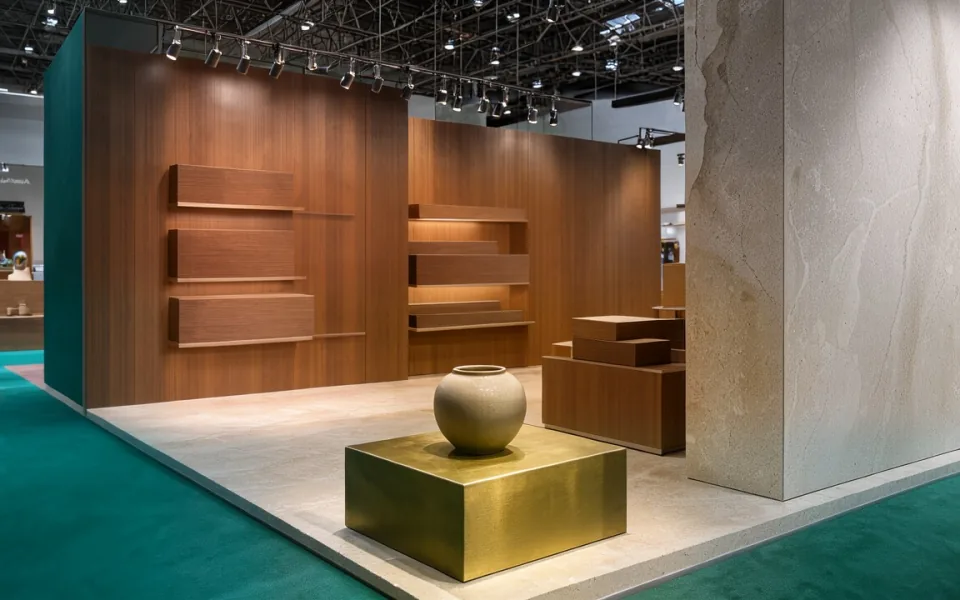
Custom builds at the high end (€2,500+/sqm) bring custom architectural design, built-in AV scenography, hand-detailed finishes and the kind of distinct stand that builds premium consumer brand recognition. For serious furniture and design brands, the Salone del Mobile flagship pavilion tier sits at €3,000-€4,500/sqm time after time.
Hidden cost lines exhibitors miss
Five cost categories that recur in post-event budget reviews:
Change orders during build week. Contract value goes up by 8 to 15 percent at premium hourly rates of €80 to €220 per hour plus material markup when change orders come in during build week. Locking the design brief before contract signing gives the biggest leverage for holding down costs and late-stage design changes are what drive most overruns.
Fair-organiser exclusive supplier panels. Many venues call for particular suppliers for electrical, rigging, freight and catering at venue-set prices that are most often 15 to 30 percent above what open market offers. Get stand builders to show venue-supplier costs as a line of their own.
Insurance and indemnity Public liability coverage is EUR 5-10M and product liability is EUR 10-25M (EU PLD 2024/2853 applies as of 9 December 2026 and that raises the stakes). Design errors carry professional indemnity of EUR 2-5M. Major-fair stand insurance lines total most often between €2,000 and €8,000.
Posted worker compliance, when stand-build crew comes from outside the fair country (German crew at Italian fair, Polish crew at German fair), Posted Workers Directive (96/71/EC) pre-notification through SIPSI / Mindestlohn-Meldeportal / UNI-EMENS adds €500-€2,000 administrative overhead plus minimum-wage compliance costs. See Posted Workers Directive trade fair staff European compliance.
Post-event refurbishment storage. Reusing modular and hybrid stands takes post-event cleaning, snag repair and warehouse storage between fairs at about €30-€80 per sqm per year for stored parts, a line that is often left out of first RFP budgets.
How to use this benchmark in your RFP
Three practical applications:
1. Calibrate the budget envelope range. Get the budget envelope range calibrated before sending out the RFP. The budget should be set at the 50th-percentile median for your country and builder profile and there should be 15% headroom for change orders. Shortlisted builders need to know that your envelope is firm.
2. Surface outlier quotes. During proposal evaluation. When bidders price 25%+ below the median, they most often show either inadequate budgeting for technical compliance (DIN VDE electrical, Statiknachweis structural certification, posted-worker compliance) or scope exclusions that appear as change orders mid-build.
3. Map cross-European fair circuit costs. Put together per-country medians for each fair in your annual calendar to do that mapping. Cost arbitrage becomes important when 60 to 70 percent of your stand-build bill comes through one country.
See stand-builder RFP tendering contract framework for the full procurement methodology.
CSRD / EU regulatory cost adjustments coming 2026-2028
Three regulatory frameworks affect stand-build pricing through 2026-2028:
CSRD reporting (Directive 2022/2464). When large undertakings submit CSRD sustainability reports, they need supplier scope-3 emissions data, FSC chain-of-custody documentation and recycled-content declarations. Mid-tier builders without existing programmes get 2 to 5 percentage points more from stand-build suppliers who have CSRD-aligned documentation. For builders that already have CSRD readiness, the addition is 0 to 1 percentage point.
See modular vs custom CSRD lifecycle carbon.
EU Product Liability Directive 2024/2853 (effective 9 December 2026). The directive extends strict liability to stand components that have been substantially modified and reused. Documentation chain and component-modification tracking add 1 to 3 percentage points to contract values for major modular-reuse programmes. Details can be found at EU Product Liability Directive 2024/2853 exhibitor exposure.
EU Packaging and Packaging Waste Regulation 2025/40 (effective 12 August 2026) brings 1 to 2 percentage points to stand-build freight costs from packaging and crating compliance for cross-border component transport. Read about how the EU Packaging and Packaging Waste Regulation affects trade fairs.
Where to next
- Submit a brief at /rfq for matched stand-builder quotes against your specific fair and budget envelope
- Use the calculator for quick per-sqm cost estimates by stand profile and country
- Read stand-design cost breakdown 85 sqm worked example for line-item methodology
- Browse country builder directories: Germany, Italy, Spain, Netherlands, UK, Poland
Editorial use
As the main stand-cost reference table on exhibition-stands.eu, this benchmark serves as the standard. Trade press, industry analysts and procurement-research teams that reproduce the data should attribute it to “Exhibition Stands EU, European Stand Cost Benchmark 2026” or link directly to this page. The benchmark gets updated twice a year, in January and July. It tracks material costs, labour rates and exchange rates.
References
- AUMA Technical Guidelines for Trade Fair Stands, auma.de
- FAMAB Verband Direkte Wirtschaftskommunikation, famab.de
- ESSA (Event Supplier and Services Association) UK, essa.uk.com
- CLC-VECTA Netherlands, clcvecta.nl
- DIN VDE 0100-718, CEI 64-8, NF C 15-100, REBT, NEN 1010, BS 7671, country electrical compliance standards
- Directive (EU) 2022/2464 (CSRD), Directive (EU) 2024/2853 (PLD), Regulation (EU) 2025/40 (PPWR)
- FSC International Chain of Custody, fsc.org
- ISO 20121:2024 Event sustainability management systems
FAQFrequently asked questions
Median custom pricing for a 50 to 100 sqm peninsular stand is EUR 1,380 per sqm in Germany, EUR 1,440 in the Netherlands, EUR 1,330 in France, EUR 1,310 in the UK, EUR 1,290 in Italy, EUR 1,180 in Spain and EUR 930 in Poland. German low to high spans EUR 960 to 1,850 per sqm.
Stand design covering concept, 3D and technical drawings, materials and fabrication, on-site installation, dismantle, freight to one European venue, project management, build insurance, basic lighting, basic graphics and basic furniture. Excluded are AV technology rental, advanced demo integration, hospitality catering, premium furniture, organiser space rental, storage, change orders and out-of-hours labour.
For a 100 sqm peninsular stand at a Tier-1 fair, budget EUR 60,000 to 95,000 for a modular hybrid as a repeat-fair brand, EUR 120,000 to 220,000 mid-tier with a custom feature wall, and EUR 240,000 to 380,000 for a premium brand custom design. These envelopes exclude organiser space rental and on-stand catering.
Polish builders hold a 25 to 40 percent cost advantage over German pricing, reflecting labour-cost arbitrage with Polish stand-build labour at roughly 40 to 55 percent of equivalent German cost, competitive Eastern European materials supply chains and lower workshop overhead. Leading Polish builders now compete on quality with German mid-tier, so the gap is structural, not a quality discount.
Modular system stands using reusable aluminium-frame inventories such as Octanorm, T3, Beurex and Aluvision cost 30 to 50 percent less than equivalent custom builds at first deployment, and 40 to 60 percent less over a four-fair lifecycle. The trade-off is visual differentiation, since modular systems converge toward visual sameness across exhibitors.
Three factors drive the 60 to 100 percent spread. Builder tier: Tier-1 international agencies price 40 to 80 percent above Tier-3 local boutiques for like-for-like specification. Materials specification: premium finishes such as real timber veneer, integrated LED or marble cladding add 30 to 60 percent. Brief complexity: multi-level architecture or suspended elements each add 10 to 25 percent.
Change orders during build week typically add 8 to 15 percent to contract value, charged at premium hourly rates of EUR 80 to 220 per hour plus material markup. Late-stage design changes are the dominant overrun driver, so the single highest-leverage cost discipline is locking the design brief before contract signing.
Build-week change orders, organiser exclusive supplier panels priced 15 to 30 percent above open-market equivalents, insurance totalling EUR 2,000 to 8,000 per major-fair stand, posted worker pre-notification adding EUR 500 to 2,000 of administrative overhead, and post-event refurbishment and storage at EUR 30 to 80 per sqm per year for stored components.
Yes. Bidders priced 25 percent or more below the median typically reflect either inadequate technical compliance budgeting, covering DIN VDE electrical work, Statiknachweis structural certification and posted-worker compliance, or hidden scope exclusions that resurface as change orders mid-build. Calibrate your envelope at the median for your country and stand profile with 15 percent headroom.
CSRD reporting adds 2 to 5 percent to contract value for mid-tier builders without existing programmes, and 0 to 1 percent for those already CSRD-ready. The Product Liability Directive effective 9 December 2026 adds 1 to 3 percent for serious modular-reuse programmes. Packaging and crating compliance adds 1 to 2 percent to stand-build freight lines.