
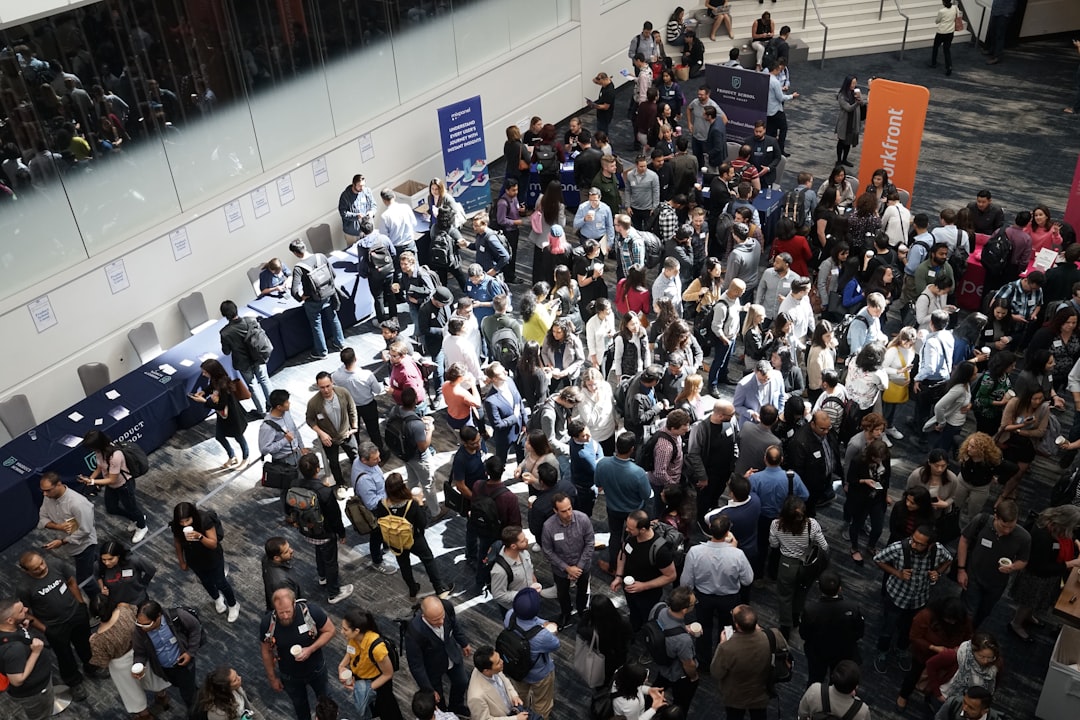
European trade fairs are the densest source of public competitive intelligence available to B2B exhibitors. One hall, five to eleven days. Every direct competitor puts its product line, pricing posture and hiring intentions on display. So are its partner ecosystem and its customer base. Senior leadership is often there too, and willing to speak to industry visitors. The intelligence available at a single tier-one fair frequently exceeds what twelve months of separate competitive research can produce.
This article unpacks how experienced European B2B exhibitors structure competitive intelligence collection at trade fairs in 2026. It covers the budget and the collection methods. It sets out the ethical boundaries under SCIP (Strategic and Competitive Intelligence Professionals) guidelines and applicable EU regulations. And it shows how the intelligence translates into strategic decisions back in the business.
The figures and methods draw on observed practice through 2025. The fairs are Hannover Messe, drupa, IFA Berlin, MWC Barcelona, EuroShop, EMO Hannover, productronica, ISE at RAI Amsterdam and Cosmoprof Bologna.
What competitive intelligence at fairs actually delivers
Three categories of intelligence are reliably collectible at European trade fairs through ethical, observable, non-deceptive methods.
The first is product-and-portfolio intelligence. Competitors physically display their current product line and new releases. Roadmap items get announced at the fair. Pricing tier structures are often shown publicly or printed in brochures. The product positioning narrative comes with all of it. Photograph publicly displayed products. Collect printed marketing materials. Listen to sales pitches any visitor can hear. All of this is ethical and entirely standard.
The second is commercial and go-to-market intelligence. Competitors signal their commercial priorities through stand investment levels, staffing scale, hospitality investment, and named-account hosting patterns. Watch stand size shifts year-over-year, presence at adjacent fairs, partner co-presence and customer-logo display. Each reveals commercial intent that desk research alone cannot replicate.
The third is organisational and talent intelligence. Competitors bring key leadership to fairs and often introduce them to industry visitors. They advertise open roles. They signal R&D investment direction through the capabilities they demonstrate, and their product priorities reveal which technologies they are betting on. Senior-leadership presence at specific fairs reveals strategic priority more reliably than any external research can.
“We collect more strategic intelligence at three European fairs per year than from twelve months of separate market research at four to five times the cost. The fair-collected intelligence is also more current, what we observe at Hannover Messe in April reflects competitive reality in April, not the six-to-nine-month-old reality that desk research captures.” Common framing among SCIP-affiliated competitive intelligence professionals working in European industrial sectors, 2024
Ethical boundaries: what is permitted and what is not
SCIP guidelines and applicable EU regulations establish clear boundaries on competitive intelligence at trade fairs. The relevant ones are GDPR, the Trade Secrets Directive 2016⁄943 and various national competition laws.
Permitted under ethical and legal standards:
- Photographing publicly visible product displays, signage, and stand graphics
- Collecting printed marketing materials displayed for visitor pickup
- Listening to sales pitches delivered to general visitors
- Engaging in conversation with competitor staff as an identified industry visitor
- Recording publicly delivered presentations (where venue permits)
- Documenting publicly observable customer-logo displays
- Note-taking on observable stand traffic, staffing, and visitor patterns
Prohibited under ethical and legal standards:
- Misrepresenting identity to gain access to non-public information
- Recording private meetings without consent
- Recruiting competitor staff for the express purpose of acquiring trade secrets
- Inducing competitor staff to breach confidentiality obligations
- Accessing non-public information (private meeting rooms, internal materials)
- Photographing materials clearly marked as confidential or not-for-publication
- Inducing customers or partners to reveal information they are obligated to keep confidential
The boundary is straightforward in principle: collect what competitors choose to display publicly; do not deceive your way into private information. Most competitive intelligence collected at European trade fairs sits comfortably within the permitted category. The discipline is in maximising what you collect from public sources, not in pushing into prohibited territory.
“The intelligence that requires deception is rarely worth the legal and reputational risk. The intelligence available through ethical collection is substantial and underexploited by most exhibitors. The framing should be: how do we systematise the collection of public intelligence, not how do we cross the ethical line.” Common framing among SCIP-affiliated practitioners
Competitive intelligence budget at European fairs
The table below summarises observed competitive intelligence collection budgets at European fairs. Figures are for collection at one tier-one B2B fair.
| Activity | Cost EUR per fair | What it produces |
|---|---|---|
| Pre-fair competitor list and target setting | 2,400-6,800 | Prioritised competitor target list |
| Dedicated CI collection staff (1-3 staff across fair) | 4,800-22,000 | Daily collection across competitor stands |
| Product photography and documentation | 1,200-3,800 | Visual record of competitor products and stands |
| Printed material collection and digitisation | 480-1,400 | Catalogued competitor marketing materials |
| Listening tour and presentation attendance | 1,200-3,400 | Transcripts of public competitor messaging |
| Stand-traffic and visitor-pattern observation | 880-2,800 | Quantitative intelligence on competitor performance |
| Post-fair intelligence synthesis and reporting | 4,800-14,000 | Internal CI report and strategic recommendations |
| Total CI budget per fair | 15,780-54,200 | Comprehensive collection and synthesis |
Take a B2B exhibitor running four major European fairs per year. Total annual CI collection budget runs EUR 60,000-220,000, typically one to three percent of total fair spend. The return typically runs many times the spend, where it is measured through the strategic decisions the intelligence informs.
Collection methods that work at scale
Five collection methods reliably produce useful intelligence at European trade fairs.
The first is structured competitor-stand walks. CI staff visit each priority competitor stand daily, photographing changes, collecting new materials, and noting visitor activity. Structured walks at the same time each day enable trend identification across the fair days.
The second is presentation attendance. Most competitors deliver scheduled presentations at their stands. Attend these as an identified industry visitor, with your company badge clearly visible. That is entirely ethical, and it produces intelligence on competitor messaging, product roadmap statements, and customer case studies.
The third is industry-visitor conversation. Talking to competitor sales staff as an identified industry visitor is ethical. It produces intelligence on positioning, pricing posture and competitive comparison narratives. The conversation must not misrepresent the visitor’s identity or employer.
The fourth is partner-and-ecosystem mapping. Competitors typically display partners, customers, and ecosystem affiliations through co-located stands, logo walls, and joint announcements. Documenting these relationships produces intelligence on competitor go-to-market strategy.
The fifth is industry-press monitoring. Competitors typically issue press releases and product announcements timed to fair days. Monitoring industry press during the fair captures the formal communications that supplement on-stand observations.
Synthesis: turning collection into strategic decision
Collection is the easy part. Synthesis, converting raw intelligence into strategic recommendations the business can act on, is where most CI programs fall short.
Three synthesis disciplines reliably produce actionable output.
The first is structured comparison framework. Skip the narrative competitor report. Produce structured comparison documents across consistent dimensions instead: product capability, pricing tier, go-to-market position, partner ecosystem and organisational signals. Comparison frameworks support direct strategic decisions.
The second is hypothesis-test framing. CI collection should start with explicit hypotheses about competitor strategy and use fair-collected intelligence to confirm or refute. Hypothesis-test framing avoids the “interesting but not actionable” output that plagues unstructured CI collection.
The third is decision-linked recommendation. Every CI report should link findings to specific business decisions. Should we adjust pricing, accelerate the product roadmap, target specific accounts or change partner strategy. Reports that observe without recommending rarely influence business decisions.
“We restructured our fair-CI program in 2022 around hypothesis-test framing. Before that we produced detailed observation reports that maybe a third of recipients read. Now we produce eight-page hypothesis-test documents that map directly to quarterly strategic reviews. The intelligence is the same; the impact is substantially different.” Common framing among AUMA member exhibitor heads of strategy
Fair-specific CI patterns
Different European fairs reward different CI emphasis. The table below summarises observed CI focus patterns.
| Fair | Primary CI emphasis | Secondary CI emphasis |
|---|---|---|
| Hannover Messe | Industrial roadmap, automation strategy | Partnership and integration ecosystem |
| drupa | Production capability, materials innovation | Pricing tier and service positioning |
| IFA Berlin | Consumer product roadmap, launch timing | Brand-position narrative |
| MWC Barcelona | Network technology direction, platform strategy | Operator-relationship strategy |
| ISE at RAI Amsterdam | Integration capability, AV roadmap | Channel-partner ecosystem |
| EuroShop Düsseldorf | Retail-technology roadmap, design direction | Sustainability positioning |
| EMO Hannover | Machine-tool capability, software integration | Service and maintenance offering |
| productronica Munich | Electronics manufacturing roadmap | Automation and AI integration |
| Cosmoprof Bologna | Product launch pipeline, ingredient strategy | Channel and distribution strategy |
The pattern: each fair concentrates a specific intelligence category that is harder to collect elsewhere. CI programs that prioritise fairs based on intelligence-collection value alongside commercial value extract substantially more strategic insight.
Common CI failures and how to avoid them
Three failure modes reliably reduce the strategic value of fair-collected CI.
The first is collection-without-synthesis. Programs that collect extensively but synthesise weakly produce reports nobody reads. The fix is to design synthesis output before collection begins, what decision will this intelligence inform?
The second is ethical-boundary drift. Programs that drift toward deceptive collection methods produce legal and reputational risk that outweighs any intelligence value. The fix is explicit ethical-boundary training for all CI staff before each fair.
The third is single-fair-event collection. Some programs treat fair CI as a one-time event rather than ongoing competitive monitoring. They miss the trend-identification value that fair-over-fair comparison produces. The fix is structured year-over-year comparison frameworks.
Tooling at Exhibition Stands EU
The /rfq workflow includes CI-collection scope as an optional add-on that some builders provide as a service. The /calculator models CI budget within the broader fair-strategy budget. The /builders directory does not list CI specialists directly; the SCIP member directory and major-consulting-firm CI practices serve that function.
Related reading
- Account-Based Marketing at European Trade Fairs
- Pre-Show Marketing
- Lead Capture and CRM Integration
- Brand Storytelling on Stand
- Stand Design Cost Breakdown
- Find a Builder
References and primary sources
- SCIP (Strategic and Competitive Intelligence Professionals) Code of Ethics
- Directive (EU) 2016⁄943 on the protection of undisclosed know-how and business information (Trade Secrets Directive)
- Regulation (EU) 2016⁄679 General Data Protection Regulation (GDPR)
- AUMA exhibitor strategic-intelligence working group papers (2024-2025)
- CEIR (Center for Exhibition Industry Research), industry research including “How Exhibitors Evaluate Outcomes” (2024)
- FAMAB Verband Direkte Wirtschaftskommunikation member best-practice exchanges
- UFI Global Visitor Insights Report 2024, ufi.org
- Council of Competitive Intelligence Fellows, ethical guidelines 2024 update
Frequently Asked Questions
What competitive intelligence is ethically collectible at European trade fairs?
SCIP guidelines and EU regulations permit a substantial range of collection activities.
Permitted: photographing publicly visible product displays, signage, and stand graphics; collecting printed marketing materials displayed for visitor pickup; listening to sales pitches delivered to general visitors; engaging in conversation with competitor staff as an identified industry visitor; recording publicly delivered presentations where venue permits; documenting publicly observable customer-logo displays; note-taking on observable stand traffic, staffing, and visitor patterns.
Prohibited: misrepresenting identity to gain access to non-public information; recording private meetings without consent; recruiting competitor staff to acquire trade secrets; inducing breach of confidentiality obligations; accessing non-public information; photographing materials marked confidential. The principle: collect what competitors display publicly, do not deceive into private information.
What does competitive intelligence collection at a fair actually cost?
For comprehensive collection at one tier-one European B2B fair, budget runs EUR 15,780-54,200 covering: pre-fair competitor list and target setting (EUR 2,400-6,800), dedicated CI collection staff of 1-3 people across the fair (EUR 4,800-22,000), product photography and documentation (EUR 1,200-3,800), printed material collection and digitisation (EUR 480-1,400), listening tour and presentation attendance (EUR 1,200-3,400), stand-traffic and visitor-pattern observation (EUR 880-2,800), and post-fair intelligence synthesis and reporting (EUR 4,800-14,000).
For a B2B exhibitor running four major European fairs per year, total annual CI collection runs EUR 60,000-220,000, typically 1-3% of total fair spend with multiple-times return on strategic decisions informed.
What three intelligence categories are reliably collectible at fairs?
Product-and-portfolio intelligence: competitors physically display current product line, new releases, announced roadmap, pricing tier structures often publicly displayed or in brochures, and product positioning narrative. Photographing publicly displayed products, collecting printed materials, and listening to sales pitches any visitor can hear are entirely ethical.
Commercial and go-to-market intelligence: stand investment levels, staffing scale, hospitality investment, named-account hosting patterns, year-over-year stand size shifts, adjacent-fair presence, partner co-presence, and customer-logo display all reveal commercial intent.
Organisational and talent intelligence: key leadership presence at specific fairs (revealing strategic priority more reliably than external research), open-role advertising, demonstrated R&D capabilities signalling investment direction, and technology bets revealed through product priorities.
What collection methods work at scale at European fairs?
Five methods reliably produce intelligence. First, structured competitor-stand walks: CI staff visit each priority competitor stand daily, photographing changes, collecting new materials, noting visitor activity at the same time each day to enable trend identification.
Second, presentation attendance: most competitors deliver scheduled stand presentations; attending as identified industry visitors produces intelligence on messaging, roadmap, and case studies. Third, industry-visitor conversation: engaging competitor sales staff as identified industry visitors (without misrepresenting identity or employer) reveals positioning, pricing posture, competitive comparison narratives.
Fourth, partner-and-ecosystem mapping: documenting co-located stands, logo walls, joint announcements reveals competitor go-to-market strategy. Fifth, industry-press monitoring: competitors time press releases to fair days; monitoring captures formal communications supplementing on-stand observations.
Why do most CI programs fail to influence business decisions?
Three failure modes reduce strategic value. First, collection-without-synthesis: programs that collect extensively but synthesise weakly produce detailed observation reports nobody reads. The fix is designing synthesis output before collection begins, what decision will this intelligence inform?
Second, ethical-boundary drift: programs that drift toward deceptive collection methods produce legal and reputational risk outweighing intelligence value. The fix is explicit ethical-boundary training for all CI staff before each fair. Third, single-fair-event collection: programs treating fair CI as one-time events miss trend-identification value from fair-over-fair comparison.
The fix is structured year-over-year comparison frameworks. AUMA member exhibitors report restructuring fair CI around hypothesis-test framing (vs narrative observation) substantially increases strategic decision linkage.
Which European fairs concentrate which kind of competitive intelligence?
Each fair concentrates intelligence categories harder to collect elsewhere. Hannover Messe: industrial roadmap and automation strategy, partnership and integration ecosystem. drupa: production capability and materials innovation, pricing tier and service positioning. IFA Berlin: consumer product roadmap and launch timing, brand-position narrative.
MWC Barcelona: network technology direction and platform strategy, operator-relationship strategy. ISE at RAI Amsterdam: integration capability and AV roadmap, channel-partner ecosystem. EuroShop Düsseldorf: retail-technology roadmap and design direction, sustainability positioning.
EMO Hannover: machine-tool capability and software integration, service and maintenance offering. productronica Munich: electronics manufacturing roadmap, automation and AI integration. Cosmoprof Bologna: product launch pipeline and ingredient strategy, channel and distribution strategy. CI programs that prioritise fairs based on intelligence-collection value alongside commercial value extract more strategic insight.